How to Understand What You Recite in Prayer
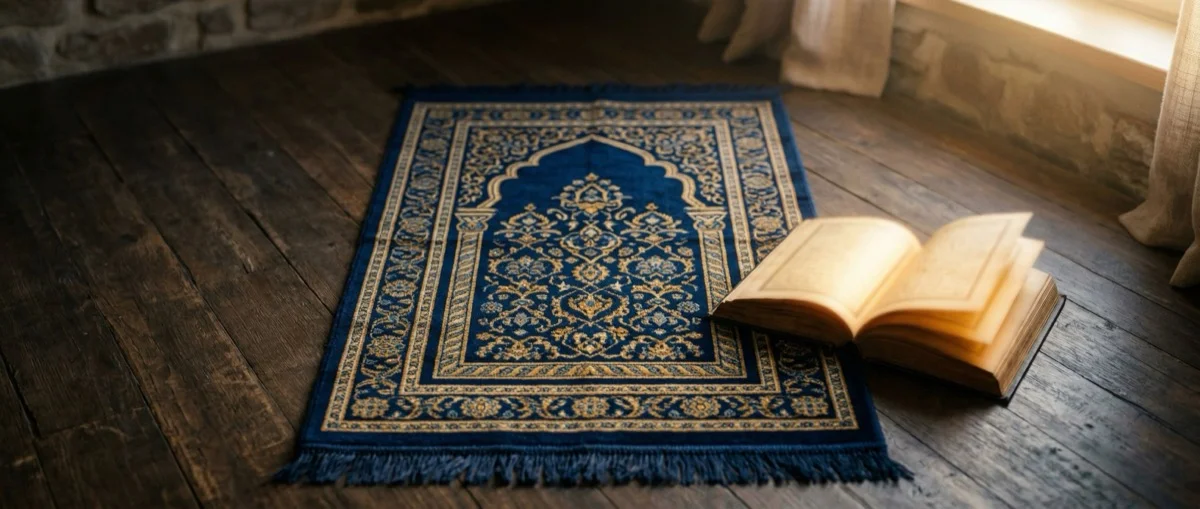
You pray 5 times a day — at least 17 rakahs — repeating the same Arabic words every time. But do you know what you're saying? Most non-Arab Muslims recite their prayers without understanding a single word. Yet learning just a few dozen words can completely transform your experience of salah.
Do you know what you say 17 times a day?
Let's do the math. The 5 obligatory prayers amount to 17 rakahs per day. In each rakah, you recite Al-Fatiha. You say "Allahu Akbar" at every change of position. You repeat "Subhana Rabbi al-Azim" in ruku, "Subhana Rabbi al-A'la" in sujud.
Over a year, that's more than 6,000 recitations of Al-Fatiha. Six thousand times the same words. Six thousand opportunities to feel the meaning of what you say. Or six thousand moments where the words pass without leaving a trace.
This isn't a question of faith. The one who prays without understanding and the one who prays with understanding both intend to draw closer to Allah. But the experience is not the same. Not at all.
What words do you recite in your prayer?
Al-Fatiha: your daily conversation with Allah
Al-Fatiha is not just a surah. It's a dialogue. A hadith qudsi reports that Allah said: "I have divided the prayer between Myself and My servant into two halves." Every verse of Al-Fatiha is a word you address to Allah, and He responds.
Here are the key words to know:
- Al-Hamd — praise. Not just any praise: complete, total praise that encompasses everything.
- Rabb — Lord, but also Nurturer, the One who causes growth. When you say "Rabbi al-'alamin," you acknowledge He is the Lord of all the worlds.
- Al-Rahman, Al-Rahim — The Most Merciful, The Especially Merciful. Two names from the same root "rahma" (mercy). Rahman is universal mercy, Rahim is particular mercy for the believers.
- Malik — Master, Sovereign. "Maliki yawm al-din": Master of the Day of Judgment.
- Na'budu — We worship. From "'ibadah," worship.
- Nasta'in — We seek help. The moment you acknowledge that without His help, nothing is possible.
- Sirat — The path. "Ihdina al-sirat al-mustaqim": Guide us to the straight path.
When you know these words, every recitation of Al-Fatiha becomes a moment of awareness. You are no longer reciting — you are speaking.
The phrases of ruku and sujud
"Subhana Rabbi al-Azim" (ruku): Glory to my Lord, the Magnificent. Three words. "Subhana" means glory, purity, perfection. "Rabbi": my Lord. "Al-Azim": the Magnificent, the Great. When you bow, you proclaim the greatness of the One before whom you bow.
"Subhana Rabbi al-A'la" (sujud): Glory to my Lord, the Most High. In the lowest position — your forehead on the ground — you invoke the One who is the Highest. The contrast between your position and His attribute is striking. When you understand it, sujud will never be the same.
"Sami'a Allahu liman hamidah": Allah hears the one who praises Him. Every time you rise from ruku, you affirm that Allah hears you. He hears your praise. You are not alone in this prayer.
"Rabbana wa laka al-hamd": Our Lord, and to You belongs all praise. Your response. A direct exchange.
The tashahhud: the testimony
"Al-tahiyyatu lillah": All greetings are for Allah. "Al-salawatu": the prayers. "Al-tayyibat": the good things. Everything that is good, pure, beautiful — it is for Him.
"Al-salamu 'alayka ayyuha al-nabi": Peace be upon you, O Prophet. At this moment in your prayer, you greet Prophet Muhammad (peace be upon him). When you understand these words, this greeting becomes deeply personal.
What is the difference between reciting and understanding?
When you say "Iyyaka na'budu wa iyyaka nasta'in" and you know you're saying "You alone we worship, and You alone we ask for help" — this verse becomes a declaration. A commitment. A moment of truth between you and your Creator.
The tears that sometimes flow in prayer don't come from the melody. They come from the meaning.
The supplications between positions: every word matters
Beyond the surahs and main phrases, your prayer contains quieter supplications that are just as rich in meaning.
"Rabbana atina fi al-dunya hasanatan wa fi al-akhirati hasanatan wa qina 'adhab al-nar." This supplication that many recite in the final tashahhud means: "Our Lord, grant us good in this world and good in the Hereafter, and protect us from the punishment of the Fire." When you know "Rabbana" (our Lord), "dunya" (this world), "akhira" (the Hereafter), "hasana" (good, blessing), and "nar" (fire) — this supplication stops being a memorized formula. It becomes a conscious request, a need you express with conviction.
"Allahumma salli 'ala Muhammad." The prayer upon the Prophet in the tashahhud contains "salli" (send blessings upon) and "'ala" (upon). Two simple words that transform this passage into a conscious act of love toward the Prophet (peace be upon him).
Even the simple "Amin" you say at the end of Al-Fatiha — when you know that you have just asked Allah to guide you to the straight path, your "Amin" carries a different intensity. It is no longer a reflex. It is an affirmation.
The cumulative effect: when understanding becomes natural
At first, you will recognize a word here, another there. This is normal. Learning Quranic vocabulary is gradual, and every new word expands your field of understanding.
Then one day, something happens. The imam recites a verse you have never studied, and you understand it. Not because you learned that specific verse, but because you know enough words to piece together the meaning. This is the moment when learning bears fruit — when individual words become global comprehension.
This moment is different for everyone. For some, it comes after 100 words. For others, after 200. But it always comes. And when it does, your relationship with prayer and the Quran changes permanently.
Quran Progress users often describe this moment as a "click." After weeks of regular learning — 5 minutes a day, a few words at a time — suddenly, the Quran "speaks" to them. The words they have been reciting for years finally carry meaning. And prayer becomes what it was always meant to be: a dialogue.
How can you learn the words of your prayer?
Step 1: Start with Al-Fatiha
It's the surah you recite most. Learn its 25 unique words. With Quran Progress, it takes just a few days. Every word is presented with its translation, transliteration, and audio pronunciation.
Step 2: The recurring phrases
Learn the words of the prayer dhikr: Subhana, Rabbi, Azim, A'la, Sami'a, Hamd. These are about ten words that come back in every rakah.
Step 3: The short surahs
Al-Ikhlas (4 verses), Al-Falaq, Al-Nas — the surahs you most often recite after Al-Fatiha. They contain fundamental words: Ahad (One), Samad (the Absolute), Rabb al-falaq (Lord of the dawn).
Step 4: The tashahhud and supplications
The final greetings, prayers upon the Prophet, and supplications before the salam. Every word carries weight. Every word deserves to be understood.
How can 5 minutes a day transform your 5 daily prayers?
Quran Progress is used by over 500,000 people to learn Quranic vocabulary. The words of your prayer are among the most frequent words in the Quran — they are the first ones you'll learn.
5 minutes a day. A few words. And gradually, each of your 5 daily prayers transforms. You no longer recite sounds. You speak to Allah. And you understand what you're telling Him.
Frequently asked questions
Why is it important to understand what you recite in prayer?
Prayer is a dialogue with Allah. Understanding the words you speak transforms salah from a mechanical ritual into a profound spiritual experience. The Prophet (peace be upon him) said that prayer is the believer's ascension. That ascension is far more powerful when you understand every word.
How many different words do you recite in a prayer?
A standard prayer contains between 50 and 100 unique Arabic words depending on the surahs recited. Al-Fatiha alone contains about 25 unique words. Repeated phrases occur in every rakah. By learning these core words, you will understand the majority of what you say in every prayer.
Where should I start to understand my prayer?
Start with Al-Fatiha, the surah you recite at least 17 times a day. Learn the meaning of each word: Alhamdulillah (praise be to Allah), Rabb (Lord), Rahman (Most Merciful), Rahim (Especially Merciful), Malik (Master), Yawm (day), Din (judgment). Then move on to the phrases of ruku and sujud.
Related articles
Ready to transform your prayer? Join over 500,000 users.